Saturday, March 12, 2011

Mud Snake

The Mud Snake is a fairly long snake, growing to be between 38 and 80 inches long. It is shiny blueish-black in color with dark pink or red bars across its belly that cross onto its sides. Unlike some other snakes, the mud snake has smooth scales and a pointed, short tail compared to its body.

This snake is active at night, especially after heavy rains. It lives in swampy lake areas, flooded plains, or at the bottom of mud-filled streams. They are common throughout the southeastern USA, but like to be left alone and are rarely seen. During the day the snake hides under wet leaves or in moist wood. Mud snakes spend the winters buried in soil and mud until the warmer weather returns. They eat tadpoles, frogs, and fish--but their favorite food is a small eel-like salamander called a siren. The large teeth at the back of the upper jaw help the mud snake grab and kill its prey

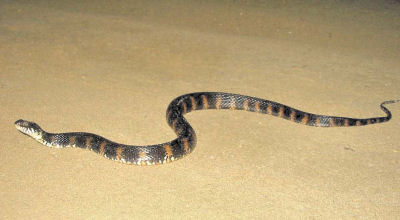
Banded Water Snake

Banded Water Snake (Nerodia fasciata):  A snake with a faint banded pattern over a dark background of black, brown, or reddish.  Sometimes called  "water bandits", these are very abundant snakes in this area, occurring in grassy ditches, swamps, ponds, streams, and rivers.  They swim well and often dive underwater.  Frogs and fish are their primary prey.  These snakes are ill-tempered and bite if handled.

snakes catogory

Brown Water Snake (Nerodia taxispilota):  
A large (to 4 feet), chunky, brown, patterned snake with eyes almost on top of its' head.  These fish-eaters climb well, and are commonly seen basking on tree branches hanging above the Canoochee and Ogeechee Rivers.  Bites only if molested, swims underwater rapidly to escape.

snakes

Snakes are possibly the most misunderstood, and most naturally hated living things on the planet. From the two thousand odd kinds of reptiles in the world, only 20% can give you a poisonous bite. The general population have an instinctive fear of snakes leading back for thousands of years. Maybe it came into existence as a survival instinct, when there was no manner of assessing if a snake was poisonous or merely harmless.

snakes is mainly belong three category. those are......
poison-less snakes
medium  poisonous snakes
poisonous snakes
 
poisoneless snakes
 
Brown Water Snake 
Banded Water Snake 
Eastern Indigo Snake 
Mud Snake
Scarlet Kingsnake
Scarlet Snake 
Corn Snake
Eastern Kingsnake
Eastern Coachwhip
Black Racer
Rough Green Snake
Eastern Hognose Snake
Ringneck Snake
Redbelly snake 
Eastern Garter Snake
Eastern Ribbon Snake


Sunday, February 27, 2011

sri lankan frog


I found a Sri Lanka Bullfrog aka. Sri Lanka Painted Frog Kaloula taprobanica, while I clearing a garbage bin, outside my Kitchen on 23 November, 2007. It was hiding underneath the bin. And with its distinctive color pattern, it caught my attention straightaway. This was my first encounter with this little frog. But I knew what it was the very moment I saw it. This frog has an interesting life-cycle, and is known to live a life of underground existence during the dry times, at times being found in 10-12 feet below, at times! It surfaces out during the wetter times for breeding.


A frog is a fresh-water amphibian of the family Ranidae. They are called name as toad. The Ranidae are sometimes called the "true frogs" since a few members of other families also have common names including the word "frog.".

In many parts of the world the frog population has declined drastically over the last few decades. Pollutants are one cause for this decline but other culprits include climatic changes, parasitic infestation, introduction of non-indigenous predators/competitors, infectious diseases, and urban encroachment.

Frogs generally come out in the night. There are more color and more specific frogs in the world

.

Dendrobates azureus is a type of poison dart frog found in the forests surrounded by the Sipaliwini savannah, which is located in southern Suriname and Brazil. Dendrobates azureus is widely known as the Blue Poison Dart Frog or by its Tirio Indian name, Okopipi. It takes its species name from the fact that it is colored azure.

Saturday, February 26, 2011

There are more amphibians in the world. this web site support to you to find any Amphibians with live in  anywhere.I think this information is useful  to everyone who surfing this site.you can visit Amphibians where in the wold and  hereditary to Sri Lanka.you can see through this site birds,fishes,rain forest,waterfalls,tourism places and any more........


you can see amphibians ssuch as frogs, salamanders, and caecilians.